Friday, June 29, 2007

New York, New York

Three completely independent articles regarding New York caught my eye today:

City May Seek Permit and Insurance for Many Kinds of Public Photography - New York Times:

"Some tourists, amateur photographers, even would-be filmmakers hoping to make it big on YouTube could soon be forced to obtain a city permit and $1 million in liability insurance before taking pictures or filming on city property, including sidewalks."
"To Extort and Serve" - Reason:
"During the last round of contract negotiations, the Patrolmen's Benevolent Association promoted the rookie-cop salary cut in exchange for raises for senior serving cops....

"Whereupon the PBA took to accusing City Hall of being responsible for the crisis the union itself essentially had created - in the expectation of keeping the higher pay for senior cops as public pressure forced big raises for rookies."
City of Liberty - Reason:
"But New York also is the breeding ground for a unique and growing American political tendency — the modern American libertarian movement. It might seem ironic that a city that has been, at various times, one of the most overly governed and poorly governed of American cities should be a launching point for the political philosophy of strictly—sometimes totally—limited government. But it is, because of virtues that no amount of poor, local government can kill."
I found the third article quite ironic given the first two.

Thursday, June 28, 2007

Two More SCOTUS Decisions

The Supreme Court has been announcing a lot of 5-4 decisions lately. Two of the latest are lifting the ban on retail price floors and ruling that race cannot be used to determine school assignments for students. I highly encourage you to read up on both decisions.

Seller Concessions

If you're interested in economics and finance, you should read Another Look at “Sellers’ Concessions” in Real Estate over at Freakonomics; it's a good read.

Net Neutrality

Apparently, the FTC has frowned on ensuring Net Neutrality by way of new regulations. The quotes are great and speak for themselves:

"'In the absence of significant market failure or demonstrated consumer harm, policy makers should be particularly hesitant to enact new regulation in this area,' FTC Chair Deborah Platt Majoras wrote.

"Majoras asserted that broadband Internet access was 'moving toward more – not less – competition.' (Complete statement - pdf file)

"'The primary reason for caution is simply that we do not know what the net effects of potential conduct by broadband providers will be on all consumers, including, among other things, the prices that consumers may pay for Internet access, the quality of Internet access and other services that will be offered, and the choices of content and applications that may be available to consumers in the marketplace,' Majoras said.

...

"'Broad regulatory mandates that employ a "one size fits all" philosophy, without regard to specific facts, always have unintended consequences, some of which may be harmful and some of which may not be known until far into the future,' she said at the time.

...

"'Policy makers should be wary of enacting regulation solely to prevent prospective harm to consumer welfare, particularly given the indeterminate effects on such welfare of potential conduct by broadband providers and the law enforcement structures that already exist,' the agency said in its conclusion."
The article also reports on some opposing viewpoints as well as the issue of the US being behind several countries in terms of broadband penetration - read the entire article for more information.

Tax Everything That Moves and Then Everything That Doesn't

Toronto is considering a new tax that essentially charges people to stand on the sidewalk:

"City Hall may have another wallet wallop coming for bar and club owners, as it ponders charging to have customers wait outside on Toronto-owned sidewalks to get into establishments.

"Those behind the idea believe it will not only generate badly needed revenue but act as a kind of de facto crowd control and reduce the potential for violence downtown. But not everyone is in favour of yet another reason not to head into the core. 'Taxing the sidewalk is just another insane thing the city can do,' explodes Councillor Denzil Minnan-Wong. 'We'll tax not only anything that moves, we'll tax anything that doesn't move!'

...

"But while patrons won't pay for it, they're still sure it will wind up coming out of their pockets. "In the end the owners are going to feel the pinch and then the pinch is going to come on us," predicts Andrew Christoforou."
HT: Fark Headline

Wednesday, June 27, 2007

Home Depot and Day Laborers

From MSNBC article:

"Home Depot is tired of being forced by local governments to accommodate the day laborers who turn up in its store parking lots seeking construction work. So the Georgia-based company turned to Congress for help.

"The Senate could respond this week by attaching language to the immigration bill that would prohibit city councils from requiring home improvement stores to pay for shelters or other services to help maintain orderly day labor sites.

"The amendment, sponsored by Sen. Johnny Isakson, a Georgia Republican, is designed to curtail a practice in the California communities of Mountain View and Burbank, where city councils recently have forced Home Depot to build facilities for day laborers onsite or elsewhere, hire security staff and offer bathrooms in order to get the permits necessary for its operations.

...

"Mountain View is considering a proposal to require Home Depot to pay $250,000 toward a permanent day labor center and to establish an educational outreach program for workers and contractors before building a store there. The city of Burbank required the company to build a similar hiring center at its store that opened last year and to provide the city with $94,000 to cover the costs of additional services.

"[
Laura Macias, mayor of Mountain View, California] said local governments impose requirements on developers all the time based on specific, case-by-case needs.

"'Once you're part of a community, there are land-use responsibilities, whether it's a center for day workers or traffic congestion remedies or park fees,' she said. 'To have it always fall back on the cities, that comes back on the taxpayers and it just doesn't seem fair.'

"'If you want to build and make tons of money from our community, we're going to want something in return,' Macias said."
Elsewhere in the article, the tactics of the local governments in question are called "extortion", while government representatives say that Washington has no business meddling in local affairs (a point with which I almost if not always agree). Read the whole article for more.

One of the things that I find most egregious about this situation is the stated position of the mayor of Mountain View in the last two paragraphs. She seems to assume that these centers and programs must be funded and is saying that it is better to charge Home Depot for it than the taxpayers. She also seems to ignore completely the fact that, if Home Depot makes a lot of money by opening that store, they are, by definition, contributing to the community in the form of providing goods and/or services that people obviously value - to say nothing of the fact that Home Depot is paying taxes on all that money they're making anyway.

Government Efficiency

Cato has a great post regarding efficiency (or the lack thereof) in government programs:

"One of the behind-the-scenes initiatives of President Bush’s budget staff the past six years has been something called the Program Assessment Ratings Tool (PART) analysis. It’s an effort to measure the 'effectiveness' and 'efficiency' of nearly 1,000 federal programs. Each program is graded on how well they achieve their 'goals,' with marks ranging from 'effective' (the equivalent of an A grade) to 'ineffective' (the equivalent of an F grade)."
The post then goes on to discuss whether we should be happy that some program get A's - after all, most of them are things we don't want the government doing in the first place and, therefore, it might be better if they did them poorly. You should read the entire post.

Equal Protection

Remember that guy from Wisconsin whom the state disallowed to give discounts on gasoline? Well, he's suing the state alleging that "the law, known as the Unfair Sales Act, makes it illegal for retailers to sell gasoline without marking it up either 6 percent over what they paid or 9.18 percent over the local wholesale price - whichever is higher" is illegal because it violates his constituional right to equal protection:

"Raj Bhandari argues in the lawsuit that Wisconsin's minimum markup law violates the state constitution's equal protection clause because retailers who sell gasoline are unfairly singled out for regulation.

"'I should be allowed to give whatever discounts I want to give to the people in order to run my business,' Bhandari told reporters Tuesday on the steps of the Dane County Courthouse in Madison."
While I agree that the law is completely unnecessary and should be stricken from the books, I'm not sure how well this argument about equal protection is going to fly. I expect Cato or Reason will have a more penetrating analysis soon.

HT: Fark headline

Monday, June 25, 2007

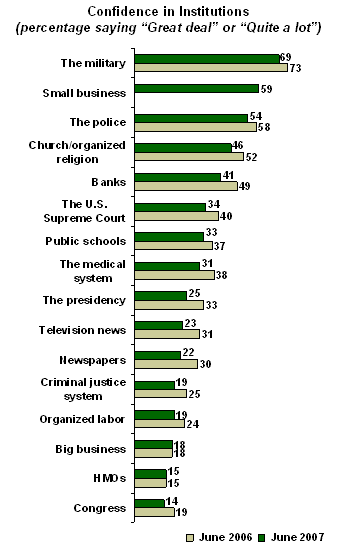
Some Fun Poll Numbers

From Gallup:

Some of the relative numbers are quite interesting, e.g., small vs. big business, and the various branches of government relative to each other. See the entire article for some historical trending.

Ethanol: Food vs. Fuel

Reason has a great article entitled "Feed SUVs and Starve People?" in which is discussed the over arching global impact of diverting resources that would otherwise represent food (corn, sugar, etc.) to ethanol production. Definitely worth the read.

Sunday, June 24, 2007

More on the Pay Gap

From U.S. News and World Report article:

The April release of Behind the Pay Gap by the American Association of University Women Education Foundation reported that one year after college graduation, women working full time earn just 80 percent as much as their male counterparts. The report noted that one potential reason for this difference is that female students are clustered in college majors tied to careers that lead to smaller paychecks. Areas such as education, health, and psychology are dominated by women, while men make up the majority of engineering, physical science, and mathematics majors—occupations that typically pay more.

Identical Sets

Apparently, "Consumers" and "Taxpayers" are two different sets of people.

Saturday, June 23, 2007

Some Light Reading

The always interesting TCSDaily has two recent essays I recommend.

The first is The Cultural Illiteracy of the Easy Atheists. In it Mary Grabar posits that the irritatingly simplistic arguments of popular atheist writers such as Christopher Hitchens is a result of the irritatingly simplistic arguments put forward by poorly educated "Christians" and their anti-intellectual sentiments.

I am sad to say that if you go into a Christian bookstore you will not see Dostoyevsky on the shelf. Instead, you'll find pastel-covered saccharine tomes, the pious stories of easy Christianity that the devout Catholic Flannery O'Connor disparaged.

Of course, easy Christianity is vulnerable to easy atheism, which is what is offered in Hitchens' tome. It's a shame the great works of Christian literature are not to be found on the shelves of Christian bookstores. It's a bigger shame that they haven't done any good on Christopher Hitchens' bookshelf either.
It is enough to make one long for the sharp, well reasoned atheism of Bertrand Russel.


The other interesting read is by Joshua Spivak, about Third Party Candidates and why the can never win.
While this election may be different from its predecessors, we can be sure that it will not be because of a third party victor. There is the same infinitesimal chance for a successful third party run as there has been for nearly 100 years. And every smart politician knows this.
. . .
The last third party candidate to even garner an Electoral College vote was Southern protest candidate George Wallace in 1968. And you have to go back to 1912 for the only time a third party candidate ever came in as high as second in a race, when former President Teddy Roosevelt, who bolted from the Republicans ran under the banner of the Progressive Party, received 88 electoral votes, and 27% of the popular vote to beat out Republican William Howard Taft. Of course, Roosevelt finished a distant second in the race to Woodrow Wilson.

He also points out that the rage liberals feel toward Nader to this day is proof that Third Party Candidates can have an impact.

Democrats Offer Universal Health Care. Republicans offer ...

National Review has an article pointing out that unless the Republican candidates put forward an alternative to the universal health care proposals being floated by their opponents, they will lose the issue to the left. It is a good summary of the arguments against government-run health care, although it contains nothing really groundbreaking.

On a related note, Michael Cannon at Cato-at-Liberty makes an excellent point about insurance and free markets that I dearly wish I had made myself.

GEICO is for-profit. Like Humana, GEICO takes its customers’ money and every claim paid is a loss to the company. Those incentives are the same. Yet we don’t have an auto repair crisis. In fact, GEICO boasts on the radio that it pays claims so quickly, it steals other insurers’ customers. Why the difference?

I would venture that the main difference between auto insurance and health insurance is that you are ultimately responsible for the cost of maintaining your car. Auto insurance does not cover new tires or oil changes or routine repair. It covers catastrophic incidents, and any claim you make will be made knowing it will cost you a deductible as well as higher rates. With health insurance, most people expect it to cover every health-related cost 100%. Of course the costs keep going up!

Undercover Cops Monitor When Your Trash Goes Out

Via UPI

A local council in London is paying plainclothes officers £30,000 pounds ($60,000) a year to track down homeowners who take out their trash at the wrong time.
. . .
Citizens say city government is being too heavy-handed in its approach to trash collection rules.

"We are living in a world where everything we do is watched and regulated," said Christine Melsom, founder of a group that campaigns for council-tax reform. "George Orwell has arrived. If you go to work early it is difficult to get it right with the rubbish."

HT Reason

Thursday, June 21, 2007

Speaking of American Productivity . . .

Question: "How many Americans does it take to build a concrete Stonehenge without any mechanical equipment?"
Answer: "One."
Bonus: He's from Flint, Michigan.


HT: Fark

American Productivity

The New York Times has a very interesting article entitled "How the U.S. Has Kept the Productivity Playing Field Tilted to Its Advantage" which is well worth reading in entirety (especially the last paragraph).

Excerpt:

"For all the collective hand-wringing, the United States is still home to the most productive workers of all the major economies — more than Japan, more than China, more than Germany, Britain, France or most any other nation on earth.

...

"The data has mostly backed up the notion of convergence among rich countries for decades. The United States miracle of the 1990s was that our productivity began growing faster than that of other countries, even though we were the richest to start with.

"The popular explanation, of course, pointed to information technology and, specifically, to the fact that the price of semiconductors began falling at an even more rapid rate than they had been, starting in the 1990s.

...

"The only problem is, the explanation doesn’t work, according to John Van Reenen at the London School of Economics. Professor Van Reenen is a leader of a new generation of economists studying the differences in economic performance across countries and businesses.

"He said that the prices of information technology fell in Europe, too. And Europeans bought information technology. But they had no productivity miracle.

"To explain the experience in the United States, one would have to believe that Americans have some better way of translating the new technology into productivity than other countries. And that is precisely what Professor Van Reenen’s research suggests.

...

"When Americans take over a business in Britain, the business becomes significantly better at translating technology spending into productivity than a comparable business taken over by someone else. It is as if the invisible hand of the American marketplace were somehow passing along a secret handshake to these firms.

...

"But that is, of course, the paradox of the American position. We hate experiencing major adjustments and industry transformations that force people to look for new jobs. That experience has made many skeptical about the future of the United States in the world economy. Yet the evidence seems to show that for all our dissatisfaction, we are the most flexible economy around and may be best poised to take advantage of the coming changes on a global scale precisely because we are so good at adjusting.

"Perhaps the lesson from the research can be boiled down to something most Americans clearly understand: The world economy may be tough on your industry but look on the bright side: you could be French."

More on Microsoft

Cato has an interesting post regarding the Microsoft issue. Also, in case you missed it, there is a good debate going on in the comment thread of that post. Check it out.

Wednesday, June 20, 2007

Ethanol Strikes - Vol. IV

Today's installment: milk.

More Details on Wal-Mart Financial Services

From MSNBC:

"The world's largest retailer will begin offering a prepaid Visa debit card, which users can reload with more money. The card won't require a credit check or bank account, a feature sure to appeal to Wal-Mart customers who may not have a checking account or other options for non-cash payments.

"Wal-Mart also will add hundreds of in-store centers bundling the financial services it already offers, such as payroll check cashing and money transfers. The number of so-called MoneyCenters will rise from about 225 now to 1,000 by the end of 2008.

...

"The reloadable prepaid Visa card, dubbed the Wal-Mart MoneyCard, will be rolled out nationally in partnership with General Electric Corp. subsidiary GE Money and with prepaid card company Green Dot. It can be used anywhere that accepts Visa debit cards and can be reloaded at Wal-Mart stores or Green Dot locations, Wal-Mart said.

...

"Wal-Mart says that it saved customers about $250 million last year by charging fees that are lower than those at other outlets. Payroll check cashing, for example, costs a fee of 1 percent or a maximum of $3.00."

Another One Bites the Dust

Drudge Report Headline: "New Hampshire: Live free or don't smoke? Statewide smoking ban passed..."

Apparently, Being Competitive Is Illegal

From Reuters:

"U.S. antitrust authorities confirmed on Tuesday they reached an accord with Microsoft Corp. requiring the company to modify its Vista operating system in response to complaints its desktop search function puts Google Inc. and other potential competitors at a disadvantage.

"The Justice Department said Microsoft would create a 'mechanism' for computer users and manufacturers to select a default program to handle desktop search."
More from the New York Times:
"Google maintained that its desktop search program, available as a free download, was slowed by an equivalent feature that is built into Vista. When the Google and Microsoft search programs run simultaneously, their indexing programs slow the operating system considerably, Google contends. As a result, Google has said that Vista violated Microsoft’s 2002 antitrust settlement, which prohibits Microsoft from designing operating systems that limit the choices of consumers."
So, let me get this straight, Microsoft is being punished for allegedly putting its competitors at a disadvantage. Well, heck, we better start suing every company in the US (as well as any company in any other capitalist country on which we can get our hands) since they, by definition, are either a) doing that or b) trying to do that. After all, trying to create and sustain a competitive advantage over one's rivals is what companies have to do to remain competitive, stay in business, and, ultimately, drive innovation and create value for all stakeholders (shareholders, employees, and customers).

On top of that, it is not just that Google is somehow put at a disadvantage - it's that, apparently, Microsoft is obligated to provide society with a software platform on which any other company can build software (that competes with its own, don't forget) that runs just as well as anything that is built-in. This is like saying that Ford is obligated to create a vehicle in which any after market peripheral device (radio, CD player, ejection seat, etc.) works perfectly even if it replicates something that a built-in component already does. Imagine if a third party parts manufacturer sued GM or Ford because their (the third party manufacturer) part (which, remember is, at least partially, redundant) doesn't work flawlessly in every car GM or Ford produces. That would be absurd - everyone would consider the part manufacturer responsible for the operation of their own product.

At this rate, Microsoft might as well be classified as a public utility that is beholden to society the way phone companies are. Just as phone companies are required to ask permission of the government before changing prices (up or down in many cases) and to allow others to lease their lines at wholesale prices so that third parties can compete with them using their own assets, Microsoft could be forced to submit everything it does to DOJ inspectors and to allow any company that wants to build software to do so at its expense. At least in the case of the phone companies, one could begin to make a case that the only reason the phone company is in such a great position is because there was basically a government sanctioned monopoly for decades. What's the excuse with Microsoft? They were too good at creating value for consumers?
Tuesday, June 19, 2007

Wal-Mart Financial Services

From MarketWatch article:

"Wal-Mart Stores Inc. plans to unveil new financial services Wednesday as it retrenches from its failed attempts to launch a charter bank.

"Following up on a promise to bring financial services beyond its check-cashing, express bill payments, money orders and money transfers to its customers, the world's largest retailer is expected to roll out mortgages and home-equity loans or lines of credit.

"Wal-Mart also is likely to announce that it will increase the number of stores in which it operates MoneyCenters , the financial-services only counter, from the current 170.

...

"Beefing up financial services also bows to comments Chief Executive Lee Scott has made in recent outings, including the annual meeting, of wanting to "add value" to his customers' lives by developing all sorts of low-cost programs and services.

Increasingly, retailers are adding financial services. Home Depot and Best Buy, for example, have long had credit plans while Costco offers a number of financial services, including auto financing and insurance. And just this week Kroger Co. added new products to its personal-finance site that include mortgages, home equity and pet insurance."

Monday, June 18, 2007

Ethanol Strikes Again (again)

The latest product whose price ethanol raises: gasoline. Nice.

US Teenagers and Entrepreneurship

The New York Times has an interesting article entitled "The Loose Reins on U.S. Teenagers Can Produce Trouble or Entrepreneurs" in which the phenomenon of business enterprises being undertaken by teenagers is discussed:

"A study by the Global Entrepreneurship Monitor showed that the United States was unusual among developed countries in having a higher business start-up rate among its 18- to 24-year-olds than its 35- to 44-year-olds.

...

"American youths are so successful at entrepreneurship in part because so many older and wealthier people are willing to help them. The broader American success at philanthropy, then, lays the groundwork for American entrepreneurship. By global standards, Americans may have looser networks of friends and family, but Americans are more willing to help relative strangers, and this often helps business.

...

"Compared with those in other countries, American children play a much more influential role in society and enjoy a remarkable degree of autonomy. American fast food, with its fatty, sweet and bland tastes, is geared toward children, as are many American movies and television shows. Teenagers receive higher allowances, have greater access to credit cards, and have more money to spend on culture, or, in some cases, to spend on starting a business. American labor markets are flexible enough to create a large number of jobs at the lower end of the wage scale. Teenagers are more likely to acquire work experience, and they are more likely to earn a small amount of capital for financing a start-up enterprise.

...

"It is well known that American companies have been the most successful at turning information technology into productivity advantages. In part, this is because of American success in mobilizing young talent."

Protectionism

You don't like US-style protectionism? You really wouldn't like the French-style.

Saturday, June 16, 2007

Reap What You Sow

It seems that there is going to be an over supply issue with ethanol later this year. I am shocked, SHOCKED! After all, market forces are supposed to . . . oh, wait, never mind.

But, that's not all - it gets better:

"'We expect the relentless supply of new ethanol production capacity will lead to a 70 percent decline in margins by 2009,' wrote Bank of America analyst Eric K. Brown in a report late last month. The report, 'The Ethanol Floodgates Have Opened,' downgraded ratings on several ethanol-related stocks.

"Researchers at Iowa State University also raised concerns about profit margins being battered by corn prices that, driven by ethanol, have risen from under $3 per bushel last summer to close to $4 per bushel lately. They say that will make it difficult for ethanol plants to make money. And as the ethanol supply grows, they predict, ethanol prices will drop relative to gasoline unless there’s a change in government policy to encourage more demand for it."
What a fantastic idea! Let's have a government policy change to bail out an industry that faces potential problems precisely because of government intervention.
"Ethanol now makes up about 4.5 percent of the nation’s gasoline mix, depending on location. Once that rises to 10 percent — the percentage all cars now sold in the U.S. can use without modifications — [Bruce Babcock, director of the Center for Agriculture and Rural Development at Iowa State] questions where any additional demand would come from. Given that ethanol has about two-thirds the energy content of gasoline, he said, ethanol would have to be priced at two-thirds the price of gasoline to induce a major turn toward E85, an 85 percent ethanol blend that can power flex-fuel vehicles.

"'Otherwise no one will fill up with E85,' he said.

"The chairman of the National Corn Growers Association, Gerald Tumbleson, shares that concern.

"'We call it a ’blend wall,’ said Tumbleson, who farms near Sherburn in southern Minnesota. 'If you hit that blend wall, what’s the value of our product? That’s what makes us nervous.'

"Tumbleson said corn growers are hoping to get laws changed to require even greater use of ethanol, such as a 20 percent mandate. He said America’s energy independence is at stake."

Wal-Mart and Public Policy

"Wal-Mart can demonstrate its social responsibility by defending its fundamental right to exist."

Governor Privatize

Personally, I think there are plenty of worse things a governor could be nicknamed. Indiana governor Mitch Daniels has earned the nickname due in large part to his leasing of the Indiana Toll Road to a private entity for 75 years. Predictably, privatization of government assets and/or services is being demonized by many of the usual suspects. While, in general, I support such privatization efforts, I have to say that I have heard few arguments in favor of them better than those offered by Governor Privatize:

"From his printer, he pulled out a sheet of paper bearing a one-sentence quotation attributed to a Democrat, former Gov. Mario M. Cuomo of New York: 'It is not government’s obligation to provide services, but to see they’re provided.'

"'Government is the last monopoly,' Mr. Daniels said. 'So competition is the key. That’s why I’m indifferent — public or private, as long as the benefits of competition are brought to bear.'"

Friday, June 15, 2007

In A Free Market, Money Is Free To Leave

From Richard Rahn's article on TCSDaily about the international trade connections between the US and Europe:

This past year more than one trillion dollars flowed between the U.S. and the EU. The EU now accounts for 21 percent of U.S. merchandise exports and 19 percent of U.S. merchandise imports, and about 34 percent of U.S. services exports and 37 percent of U.S. services imports.

The U.S. is not only the largest recipient of foreign direct investment, but far and away the world's largest investor elsewhere. Of the more than two trillion dollars the U.S. has invested directly abroad, a little more than half ($1.1 trillion) is invested in Europe. Europeans account for 70 percent ($1.2 trillion) of the direct investment in the U.S.

It is statistics like this that highlight the stupidity of protectionist trade policy. The US and Europe need each other, and any effort to "protect" the citizens of one at the expense of the other can only hurt both sides. Both sides of the Atlantic rely on trade, and need to realize that it is impossible to keep resources and capital locked up in a free economy. No law compatible with a free society can force local investment, or prevent those with the means from fleeing the country to someplace that offers them better opportunities. Such measure unfailingly do more harm than good, raising prices and unemployment for the benefit of politically connected industries.

Already, Europeans are fleeing their countries for the lower taxes and greater economic freedoms of the US. However, this is not a one way street. While US is a more attractive option for many individuals, the same can not be said for corporations. As Rahn notes, the EU has an average maximum corporate income tax rate of 25 percent (with some members as low as 10 percent) while the US average is 40 percent. When France and Germany both have lower taxes than the US, it is obvious something has changed. As the regulatory burden in the US rises (carbon credits, Boxly, etc.) the benefits of the lower taxes abroad become more significant.

This brings us to the flip-side of my earlier statement that laws can't force capital to stay. Though laws can't force it, they can be crafted to attract investment. If we want the US to continue to be competitive in a global market place, we should cut our corporate tax rates. I would advocate cutting them to zero. Corporations cannot pay taxes, since all costs are just passed on to the investors or consumers. If we cut corporate taxes, the money will still be taxed when it flows out to investors and employees, but not when used for reinvestment within the company. As Eastern Europe continues to cut taxes, the US cannot ignore the pressure being brought to bare as a result. If US taxes remain high, or are allowed to rise, the global markets will flow away from us, toward nations that offer a more hospitable environment.

To summarize, in a free market a nation cannot demand investment and growth, it must seduce it.

Where Is Your Voice From?

Carpe Diem linked to an accent quiz, allowing you to test where you sound like you are from.

What American accent do you have? (Best version so far)

Midland

("Midland" is not necessarily the same thing as "Midwest") The default, lowest-common-denominator American accent that newscasters try to imitate. Since it's a neutral accent, just because you have a Midland accent doesn't mean you're from the Midland.

Personality Test Results

Click Here to Take This Quiz
Brought to you by YouThink.com quizzes and personality tests.


So this is what I got taking the accent quiz. It seems quite accurate, but I notice that it doesn't seem to allow "alternate accents," like Black or Baltimore.

Wednesday, June 13, 2007

Assorted Links

Shattered Dreams: One Hundred Stories of Government Abuse
Uganda begs to use DDT to prevent thousands of deaths
Everyday Economist writes about the birth of capitalism and the forgotten juxtaposition with mercantilism.
Cafe Hayek on the illegality of illegal immigrants.
Bon Jovi realizes that there is more profit in performing music than selling music.
InformationWeek points out that the Information Economy is not about selling information, but using information to increase the value of everything else.
George Will on the Democrats' Prosperity Problem
Alan Vanneman on the sad state of disappearing nudity in American Film (via Reason)

Tuesday, June 12, 2007

Why Child Labor Laws Are Bad For Society

Psychologist Robert Epstein, author of The Case Against Adolescence, argues that teenagers should be given less freedom and more rights.

In every mammalian species, immediately upon reaching puberty, animals function as adults, often having offspring. We call our offspring "children" well past puberty. The trend started a hundred years ago and now extends childhood well into the 20s. The age at which Americans reach adulthood is increasing—30 is the new 20—and most Americans now believe a person isn't an adult until age 26.

The whole culture collaborates in artificially extending childhood, primarily through the school system and restrictions on labor. The two systems evolved together in the late 19th-century; the advocates of compulsory-education laws also pushed for child-labor laws, restricting the ways young people could work, in part to protect them from the abuses of the new factories. The juvenile justice system came into being at the same time. All of these systems isolate teens from adults, often in problematic ways.
...
Teens in America are in touch with their peers on average 65 hours a week, compared to about four hours a week in preindustrial cultures. In this country, teens learn virtually everything they know from other teens, who are in turn highly influenced by certain aggressive industries. This makes no sense. Teens should be learning from the people they are about to become.
. . .
Are you saying that teens should have more freedom?

No, they already have too much freedom—they are free to spend, to be disrespectful, to stay out all night, to have sex and take drugs. But they're not free to join the adult world, and that's what needs to change.

Not sure I agree with everything he says here, but he does make some interesting points. One observation I have made numerous times is that our society has no "Right of Manhood" (or womanhood, for that matter). Most cultures have that point where you become an adult, to go out and make your way in the world, but we have no real point where we celebrate reaching adulthood. We graduate high school, but that is just preparation for college. We finish college, but then we become "entry level" employees. There is never a solid transition, and the cultural emphasis on youth means we keep pushing the age of responsibility back.

P.S. For an alternate view on child labor, go here

Monday, June 11, 2007

Employer Matching 401(k) = Savings Account for the IRS

From the Dallas Morning News:

"Today's Rude Opinion Poll: Which description best characterizes our elected representatives in Washington, regardless of party affiliation?

"• They are hapless boobs, constantly passing laws that contradict each other.

"• They are scheming miscreants, relentlessly seeking new ways to increase taxes and spend more of our money.

"If you think the choices are unkind, please bear with me while we study a little legislative history.

"You'll see how our lawmakers have decided to take the money your employer contributes to your 401(k) plan today and transfer most or even all of it to the federal government during your retirement years.

...

"In 1983, a presidential commission recommended that Social Security benefits be taxed. The recommendation became law in 1984.

"At the time, few retirees were affected, because benefits were only to be taxed when other sources of income were quite high.

"With the initial level set at $25,000 for a single return and $32,000 for a joint return, it was expected that only 1 percent of beneficiaries would pay any taxes on their benefits.

"But there was a catch. The income levels weren't indexed to inflation.

...

"The average Social Security check is $1,048 a month, or $12,576 a year. So an average two-earner couple may have benefits of $25,152.

"Subtract half of this amount from $32,000, and you have the amount of income they can have from other sources before benefits become taxable – $19,424.

"Once their other income exceeds $19,424, every additional dollar causes either 50 cents or 85 cents of Social Security benefits to be added to their taxable income.

...

"Now let's consider the composition, and disposition, of each dollar that goes into a typical 401(k) plan.

"In a typical plan, every dollar of employee contribution is matched by 50 cents of employer contribution. So each dollar going in is 67 cents of employee money and 33 cents of employer money.

"Question: What is the composition of each dollar coming out?

"Answer: There are four levels, depending on your tax status. Here they are.

"Level 1: At this level, no Social Security benefits are taxed. Assuming a 15 percent tax rate on the 401(k) income, 85 cents of each 401(k) dollar will go to the employee and 15 cents to the IRS. That's a reasonable deal that's rapidly disappearing.

"Level 2: At this level, 50 cents of Social Security benefits are taxed for each dollar withdrawn from the 401(k). In effect, 77.5 cents of each dollar from the 401(k) will go to the employee and 22.5 cents will go to the IRS. About two-thirds of the employer contribution goes straight to the IRS.

"Level 3: Here, 85 cents of Social Security benefits are taxed for each 401(k) dollar withdrawn, and the basic tax rate is 15 percent. So 72.25 cents of each 401(k) dollar goes to the employee and 27.75 cents of each dollar goes to the IRS. About 84 percent of the employer contribution goes to the IRS.

"Level 4: As in Level 3, 85 cents of Social Security benefits are taxed for each 401(k) dollar withdrawn, but the basic tax rate is 25 percent. As a consequence, 53.75 cents of each dollar goes to the employee and 46.25 cents goes to the IRS. In effect, the entire employer contribution (33 cents) plus 13.25 cents of the employee contribution goes to the IRS.

"How this tax mess will affect you depends on your income level and your age. If you are young, odds are your employer contribution will never buy you a slice of bread. It's really a fund for the IRS.

"So I'll ask the question again: Are politicians hapless boobs or evil schemers?"
HT: Division of Labour post

Sunday, June 10, 2007

New Carbon Tax

Quebec has passed a new tax on energy producers. They expect it to raise 189 million dollars US. They also expect that the producers will not pass on the costs to consumers.

[Natural Resources Minister Claude Bechard] said he expects that the companies will absorb the higher costs, though he "can't guarantee'' that producers and refiners won't pass them on to consumers. "I don't think that we will put any pressure on the gas price,'' he said.

This is a very confident man. I bet that confidence really helps Bechard with the ladies. I can see him now, rolling up in a club, casually mentioning "I expect that the costs will not be passed on to consumers." The ladies at the bar will be swooning around him, whispering to each other in admiration, "He is so confident, I love that in a man!" Bechard will nod his head, share a knowing look with the bartender, and the other men in the room will know they are each a distant second.

At least that's what happens when I walk in a bar.

HT Greg Mankiw

Template Designed by Douglas Bowman - Updated to Beta by: Blogger Team
Modified for 3-Column Layout by Hoctro